
Web Design
3 September 2026
One-Page Website vs Full Website: Which Do I Need?
Introduction
Not every business needs a five-page website, and not every business is well served by a single page either. Here’s how to actually decide which one fits, rather than guessing.
Key Takeaway: A one-page site suits a focused, single-service business. A full multi-page site suits a business with several distinct services or enough content to genuinely need separate pages — the right choice depends on what you’re actually offering, not what looks more impressive.
In this article, you’ll learn:
- What a one-page website actually is
- What a full multi-page website adds
- A simple test to work out which fits your business
- What each costs
- Whether you can start with one and move to the other later
1. What a one-page website actually is
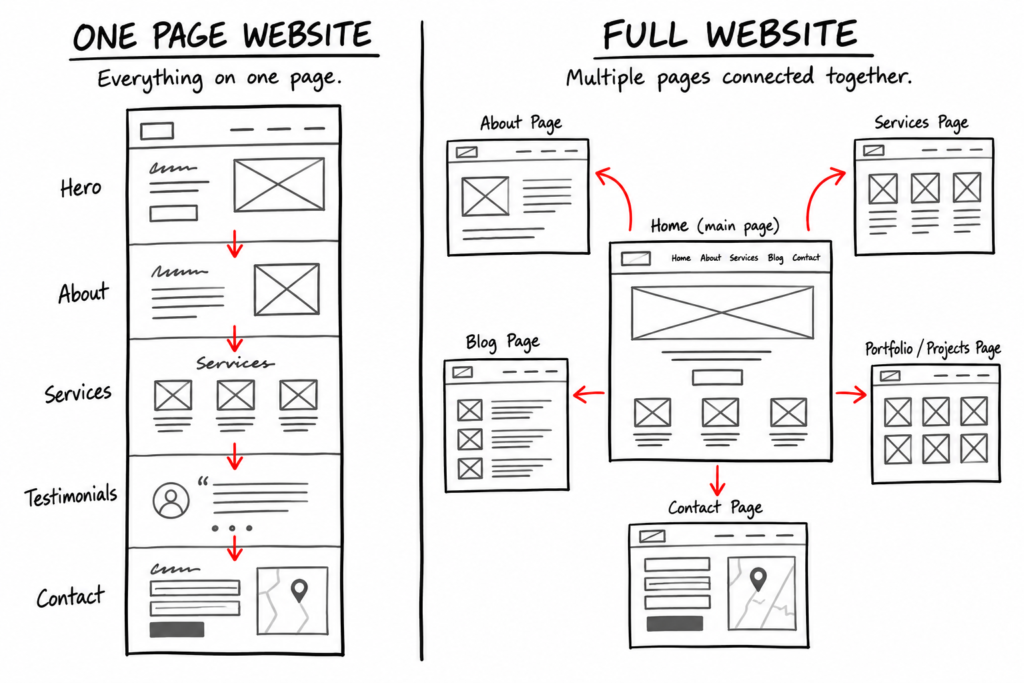
Everything — services, about, contact — sits on a single scrolling page, usually with in-page navigation jumping between sections rather than separate URLs.
Where it works well
A sole trader or single-location business offering one clear service, where a visitor doesn’t need to dig through multiple pages to understand what you do.
2. What a full multi-page site adds
Dedicated pages per service or topic
Each service gets its own page — more room to explain it properly, and each page can be found directly in search rather than competing with every other service for the same spot.
Better for local SEO
Separate pages let each one target its own specific search terms, rather than one homepage trying to rank for everything a business offers at once.
3. A simple test to work out which fits
- Do you offer one clear service, or several distinct ones?
- Would a visitor need more than a scroll’s worth of information to understand what you do?
- Are you relying on local search to bring in new customers, or mostly on referrals and existing contacts?
| Choose one-page if | Choose a full site if |
|---|---|
| You offer a single, focused service | You offer several distinct services |
| Most customers come via referral | You’re relying on local search to find new customers |
| You want the fastest, cheapest professional presence | You want each service to rank independently |
4. What each costs
One-page website
From £400 — a mobile-optimised single-page build, contact/WhatsApp buttons, basic on-site SEO, domain connection and one revision round.
Small business website (multi-page)
From £700 — up to 5 pages, a proper contact form, on-site SEO, Google Business Profile link-up, with revision rounds set out in the proposal.
Pro Tip: If you’re not sure which fits, count how many genuinely distinct services you offer. Two or fewer usually works fine as one page; three or more starts to benefit from dedicated pages.
5. Can you start with one and move to the other later?
Yes — and it’s a reasonable way to start
A one-page site now, expanded into a full multi-page site once the business grows or a second service takes off, is a perfectly sensible path — rather than overbuilding before you know what’s actually needed.
Frequently Asked Questions
Is a one-page site bad for SEO?
Not inherently — it’s simply limited to ranking for one main topic, rather than several. Fine if that matches your business.
Can a one-page site still have a blog?
Usually not practically — a blog benefits from its own archive and individual post pages, which pushes a site toward the multi-page structure.
How do I know if I have “enough content” for a full site?
If you can genuinely write a full page’s worth of useful, non-repetitive content about each service, you likely have enough for a multi-page site.
Does a full site cost much more to maintain afterward?
Modestly — more pages means slightly more to review over time, but the Website Care plans (from £29/month) cover either size the same way.
Can I upgrade from one-page to multi-page without starting over?
Often yes — much of the existing content and structure can be reused rather than rebuilt from scratch.
Conclusion
The right choice comes down to how many distinct services you offer and how much you’re relying on local search to find new customers — not which one sounds more impressive. Start with what actually fits today; you can expand later.
See both options, with real pricing, on our Website Design & Redesign page.
Related Articles
Written by MTU Projects.