
Automation
2 July 2026
What “AI automation” actually means for a small trades business
Introduction
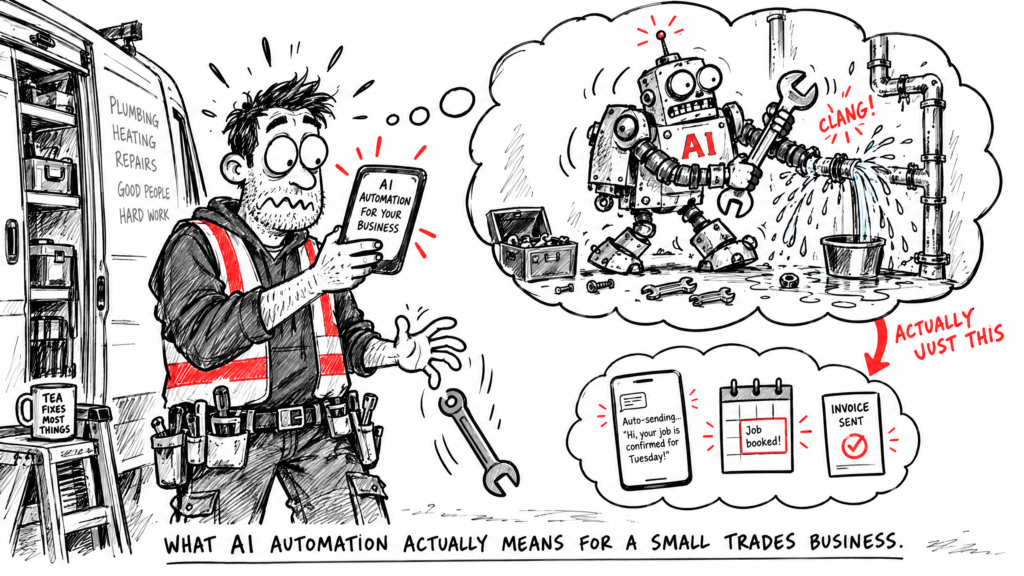
“AI automation” gets thrown around a lot, usually attached to a chatbot widget that annoys more visitors than it helps. If you run a small trades business, the useful version of AI automation looks a lot more boring — and a lot more valuable.
Key Takeaway: The automation worth having runs quietly in the background, saving you real hours a week, rather than sitting on your homepage trying to impress visitors.
In this article, you’ll learn:
- What business automation actually looks like day to day
- Why it doesn’t need a chatbot on your homepage
- The one test worth applying before automating anything
- What changes depending on the size of your business
- How to measure whether it’s actually working
1. What business automation actually looks like
For a small trades business, useful automation is a handful of systems wired together properly, not a single flashy feature.
Enquiry handling
Auto-replying to enquiries within minutes, even outside office hours, so you’re not the slowest quote in the inbox. A fast, useful acknowledgment — even before you can give a full quote — keeps you in the running.
Lead sorting
Sorting incoming leads by urgency and job type, so you spend your morning on the ones worth calling first instead of working through the inbox in whatever order it arrived.
2. Bookings and reviews, handled automatically
Two of the most time-consuming admin tasks in a trades business are also the easiest to automate properly.
Chasing no-shows
Chasing no-shows and unconfirmed bookings automatically, instead of you remembering to do it between jobs. A missed follow-up here is a missed booking, and it’s the first thing to slip when you’re busy.
Review requests
Turning a completed job into a review request the same day, while the work is still fresh in the customer’s mind — rather than remembering weeks later, by which point the moment has passed.
3. Why it doesn’t need a chatbot on your homepage
None of the above needs a flashy AI chatbot greeting visitors. It needs a handful of systems wired together properly, running quietly behind the scenes.
Where chatbots do and don’t help
| Works well | Doesn’t work well |
|—|—|
| Answering simple, repeated questions (opening hours, service areas) | Pretending to be a real conversation with a person |
| Capturing a lead’s details out of hours | Replacing a genuine quote conversation |
4. The test we use before recommending anything
Does it save real time, or is it automation for its own sake? If the answer is time, it’s worth doing. If it’s just for show, it isn’t.
Questions worth asking first
- How many hours a week does this task actually take?
- Would a customer notice or care if it were automated?
- What happens if the automation gets something wrong — is that recoverable?
5. Measuring whether it’s working
What to actually track
- Response time to new enquiries, before and after
- No-show rate on bookings, before and after
- Number of reviews collected per month
Pro Tip: Track these for four weeks before changing anything else, so you know the automation itself moved the number — not a busy month or a seasonal bump.
Frequently Asked Questions
Do I need to be technical to use this kind of automation?
No. The systems are built to run in the background — you get plain-English updates on what changed, not a dashboard to manage yourself.
Will this replace speaking to customers directly?
No. It handles the repetitive admin around a job — the acknowledgment, the reminder, the review request — so you have more time for the parts that actually need you.
Is this the same as installing a chatbot plugin?
No. A chatbot is one small, optional piece. The valuable work is usually the enquiry sorting, booking follow-ups and review requests, none of which need a chat widget at all.
How much does this cost?
It’s scoped and quoted individually, based on the workflow, integrations and support required — there’s no fixed package, because every business’s processes are different.
What if I only have one or two repetitive tasks to automate?
That’s a perfectly reasonable starting point — automation doesn’t need to cover everything at once to be worth doing.
Conclusion
“AI automation” doesn’t have to mean a chatbot on your homepage. For most small trades businesses, it means enquiries answered fast, bookings chased automatically, and reviews requested while the job is still fresh — systems that quietly save you real hours a week.
If something in your week keeps eating time it shouldn’t, see our AI business automation service or get in touch to talk through what’s worth automating first.
Related Articles
- AI Business Automation & Systems — our automation service
- The five things killing your local search ranking — the review-request point ties directly into automation
Written by MTU Projects.