
SEO
22 September 2026
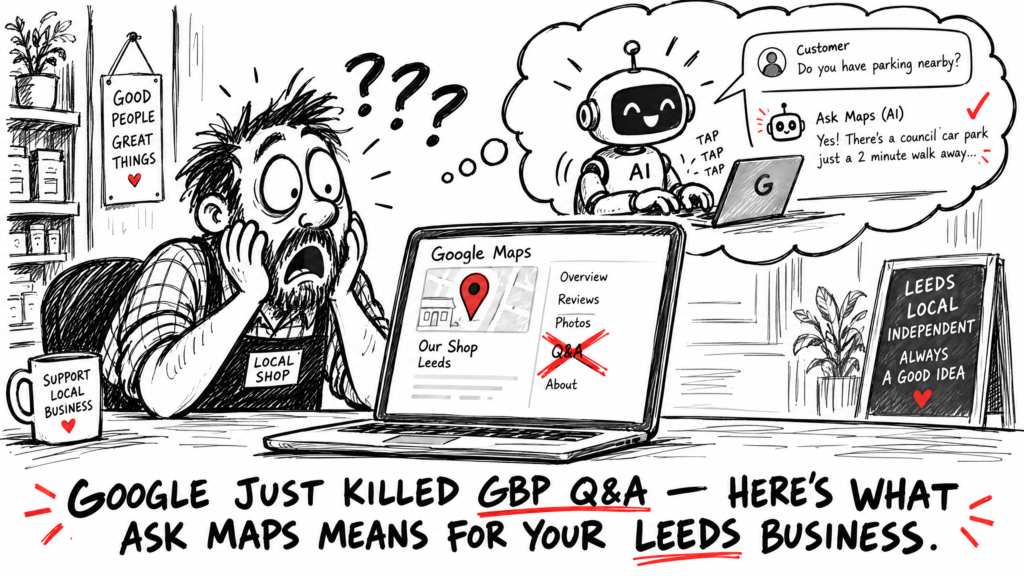
Google Just Killed GBP Q&A — Here’s What Ask Maps Means for Your Leeds Business
Introduction
If you’ve logged into your Google Business Profile recently and noticed the Q&A section has vanished, you’re not imagining it — Google has officially discontinued it. In its place is Ask Maps, an AI tool that answers customer questions about your business on its own, using whatever information it can find. For local businesses, that’s a bigger deal than it sounds: it changes who’s actually answering the questions your customers are asking, and it lands alongside a wider shift in how Google ranks local businesses at all.
Key Takeaway: Google Business Profile’s Q&A section is gone, replaced by an AI tool (Ask Maps) that answers customer questions from your profile and public information automatically — and a completeness score set by things like hours, services and photos now has a much bigger, more direct effect on whether you show up in the local pack.
In this article, you’ll learn:
- What actually changed with GBP Q&A and Ask Maps
- Why Google made the switch
- The completeness-and-ranking change happening at the same time
- What this means for a Leeds or Yorkshire business specifically
- What to check on your own profile this week
1. What Actually Changed
The Q&A section — where customers could post a question and anyone (including you) could answer it — has been discontinued. It’s been replaced by Ask Maps, an AI-powered feature that generates answers to customer questions automatically, pulled from your Google Business Profile, your website, and other public sources it can find about your business.
Alongside this, a handful of other changes are landing at the same time: native multi-location post scheduling for businesses with more than one site, WhatsApp replacing Business Chat as a customer messaging channel, and AI-generated Q&A answers that sit behind a review gate before they go live.
2. Why Google Replaced Q&A With Ask Maps
The old Q&A section had a real problem: anyone could post an answer, including competitors, and plenty of profiles had outdated or plain wrong answers sitting there unchecked for months. Ask Maps is Google’s attempt to fix that by generating answers itself, in real time, from whatever accurate information it can find.
The catch is what “accurate information it can find” actually means in practice. If your profile, website and other public listings are patchy, out of date, or inconsistent with each other, Ask Maps is working from bad source material — and it’ll say so to your customers.
3. The Bigger Change Hiding Behind It: Completeness Now Hits Rankings Harder
Ask Maps isn’t the only shift. Google’s local search algorithm has moved weight toward “popularity” signals — things like click-through rate and how much people actually engage with your profile — rather than relying mostly on historical authority.
At the same time, a March 2026 core update tightened the link between your profile’s completeness score and whether you show up in the local pack at all. Businesses missing hours, services, photos or attributes are seeing rankings drop disproportionately — a half-finished profile isn’t just missing detail any more, it’s actively working against you.
Review recency and how quickly you respond to reviews now matter more than the raw number of reviews you’ve collected. A business with 40 reviews and no recent activity can lose ground to a competitor with 15 reviews and a habit of responding to each one within a day or two.
4. What This Means If You’re a Leeds or Yorkshire Business
Local search in Leeds and the wider Yorkshire area is genuinely competitive — trades, hospitality, professional services, all fighting for the same local pack slots. These changes raise the bar in a specific direction: it’s no longer enough to have claimed your profile and left it mostly alone. Google is now actively rewarding profiles that are complete, current, and getting engaged with — and penalising the ones that aren’t.
Practically, that means:
- A patchy or outdated profile costs you more than it used to. It’s not neutral any more — it actively works against your ranking.
- Ask Maps will answer for you whether you like it or not. If your information online is wrong or inconsistent, that’s what gets repeated to your customers.
- Review habits matter more than review volume. Responding regularly beats chasing a bigger number.
5. What to Check on Your Profile This Week
A short, practical list — not a full audit, just the obvious gaps Ask Maps and the completeness score are most likely to catch:
- Hours — confirmed correct, including any seasonal or holiday changes.
- Services list — every service you actually offer, listed and described, not just the two or three you set up years ago.
- Photos — recent, and enough of them (exterior, interior, team, work examples where relevant).
- Website and address consistency — the same details on your profile as on your website and any other listings.
- Recent reviews — and whether you’ve responded to the last handful.
Pro Tip: If it’s been more than six months since you last opened your Google Business Profile dashboard, that’s usually the single biggest sign it needs attention — completeness tends to quietly decay as services, hours or photos go stale.
Frequently Asked Questions
Can I still answer customer questions directly, now Q&A is gone?
Not through the old Q&A format — that’s been discontinued. Ask Maps generates answers automatically from your profile and public information, which is exactly why keeping that information accurate matters more now.
Will a few missing details really affect my ranking that much?
According to the March 2026 update, yes — businesses missing hours, services, photos or attributes are seeing disproportionate ranking drops, not just a minor penalty.
Do I need more reviews to compete?
Not necessarily. Review recency and your response rate now weigh more heavily than raw review count, so responding consistently to what you already have matters more than chasing volume.
What is Ask Maps actually pulling information from?
Your Google Business Profile, your website, and other public sources about your business — which is why inconsistent details across those sources is a real risk, not just an inconvenience.
Is this worth sorting myself, or should I get help?
A lot of it is straightforward — hours, photos, services — and worth doing yourself as a first pass. Where it gets harder is knowing what’s actually dragging your ranking down versus what’s cosmetic, which is where a proper audit earns its keep.
Conclusion
Google Business Profile has quietly stopped being a “set it up once and leave it” listing. Between Ask Maps answering on your behalf and completeness now hitting your local pack ranking directly, a profile that’s been left alone for a year or two is actively costing you visibility, not just sitting neutral. The fix isn’t complicated — it’s making sure what’s there is accurate, current and complete — but it does need actually doing.
If you’d rather have someone check it properly, MTU Projects’ Google Business Profile audit and optimisation is a one-off £75 setup, with ongoing management from £40/month if you want it kept current. Get in touch and we’ll take a look.
Related Articles
Written by MTU Projects.