
Business Systems
12 October 2026
Quote Sent, Customer Gone Quiet: How to Follow Up Without Being Pushy
Introduction
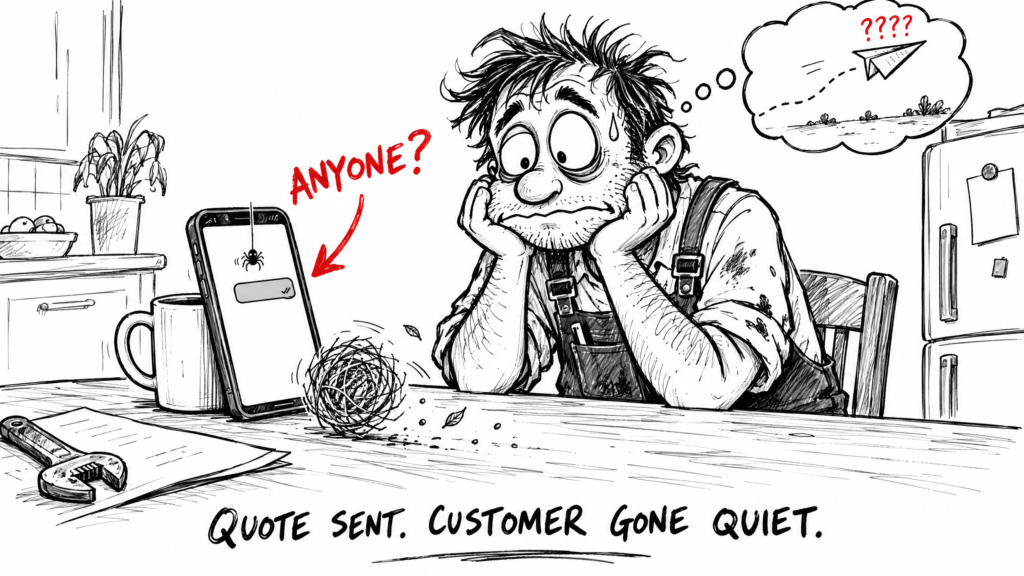
You visit, measure up, work out the price and send the quote. The customer says they’ll have a think. Then nothing. A week later you’re not sure whether to chase or leave them alone, and you’ve got other jobs on, so you do neither. Some of those quotes were never going to turn into work. Others went quiet only because nobody picked the conversation back up.
Key Takeaway: Most quotes don’t go quiet because the customer said no. They go quiet because life got busy. Put a follow-up date on every quote before you send it, keep every open quote in one list, and send short, friendly messages on that date.
In this article, you’ll learn:
- Why quotes go quiet and what it usually means
- The simple rule that stops quotes getting lost
- Three follow-up messages you can copy
- A one-page list to keep track of every open quote
- When to stop chasing
1. Why Good Quotes Go Quiet
When a customer doesn’t reply, it’s easy to assume the answer is no. Sometimes it is. But there are plenty of other reasons:
- They’re comparing a couple of quotes and haven’t decided.
- They need to talk it over with a partner or landlord.
- They got busy and forgot.
- They meant to reply and never found the right moment.
- They’re waiting until payday or the end of the month.
You can’t tell which of these it is from silence. A short follow-up is the only way to find out, and it costs you thirty seconds.
There’s also a plain fact about being busy: when you’re on the tools all day, chasing is the job that falls off the list. That’s an organising problem, not a character flaw. Which is why the fix is a system and not willpower.
2. Set the Follow-Up Date Before You Send the Quote
This is the rule that does most of the work. Before the quote leaves your hands, decide:
- When will I follow up? Pick a date, usually a few days out.
- How? The same way the customer contacted you: text, WhatsApp, email or phone.
- Who does it? If more than one person handles quotes, one name goes against each.
Write it down where you’ll see it. A diary entry, a phone reminder or a line in your list all work. The point is to take the decision out of the moment, so the follow-up doesn’t depend on you remembering.
3. Three Follow-Ups That Don’t Sound Pushy
Nobody likes being chased. They don’t mind being helped. The difference is in the wording. Change these to sound like you.
First message, two or three days after the quote:
“Hi [name], just checking my quote for [job] reached you OK. Happy to talk through anything in it if that helps.”
This one isn’t asking for a decision. It checks the quote arrived and opens the door.
Second message, about a week after that:
“Hi [name], any questions on the quote for [job]? If the timing or the scope isn’t quite right, tell me and I’ll see what I can do.”
This gives them a way to tell you the real reason, such as price, timing or the amount of work.
Last message, a week or so later:
“Hi [name], I’ll close off the quote for [job] for now so I’m not cluttering your inbox. If you’d like to go ahead later, just let me know and I’ll see when I can fit you in.”
This is polite and final. It also tends to produce a reply, because it makes the choice clear.
The timings are suggestions. A boiler replacement in January moves faster than a patio in March. Use your own sense of how urgent the job is.
4. Keep Every Open Quote in One List
If quotes live in your inbox, your van and your head, some will vanish. One list fixes that. A spreadsheet or a page in a notebook is enough.
| Customer | Job | Quote date | Amount | Follow up on | Status |
|---|---|---|---|---|---|
| Customer A | Bathroom refit | 5 Oct | £4,200 | 8 Oct | Message 1 sent |
| Customer B | Rewire, 3-bed | 6 Oct | £1,850 | 9 Oct | Waiting |
| Customer C | Fence repair | 7 Oct | £320 | 10 Oct | Won |
The customers and figures above are made up, to show the layout.
Two habits make it work:
- Check it twice a week. Ten minutes on a Monday and a Thursday. Anything with today’s date or earlier gets a message.
- Update it as you go. Change the status when you send a follow-up, and add the next date.
Start with your last five quotes. If any of them have gone quiet, the list will show you.
5. Know When to Stop
Three follow-ups is plenty. After the last message, mark the quote as closed and move on. You can always pick it back up if they get in touch.
Before you close it, put a reason against it if you know one. Over a few months, your list will tell you things:
- Price: lots of “too expensive” suggests you may be quoting the wrong people, or not explaining the value.
- Timing: lots of “not now” suggests an offer to fit them in later could win some of them back.
- Went elsewhere: if you hear about it, ask what tipped it, politely, once.
- No reply: write that down too.
Treat “too expensive” with care. Dropping your price at the first mention teaches customers to ask for a discount. A better first question is what they’d like to change: the scope, the timing or the materials. That keeps your price meaning something.
Frequently Asked Questions
How soon should I follow up on a quote?
A couple of days is reasonable for a first message. For bigger jobs people take longer to decide, so a few days to a week is normal. Use your judgement on how urgent the job is.
Should I call, text or email?
Use the same channel the customer used with you. If they texted, text back. A phone call can feel more pressured for a “just checking” message.
What if they say my price is too high?
Ask what they’d like to change before you reduce the price. Offering a smaller scope or a different spec keeps your price meaning something.
What if a customer never replies?
After three polite follow-ups, close it and make a note. You’ve done your part, and if they come back later you can pick it up again.
Is it worth automating quote follow-ups?
Once you’re sending enough quotes that a list gets hard to keep up, yes. A reminder system can prompt you or send the first check-in message automatically. If you’re sending a handful a month, a spreadsheet is fine and costs nothing.
Conclusion
Most quotes that go quiet haven’t been lost. They’ve just been left. Decide the follow-up date before you send the quote, keep every open quote in one list, and send short friendly messages on the day. Then close it off and move on. A few quotes a month rescued this way can add up to real money, and you don’t need new software to start.
When the list gets too big to manage by hand, that’s where automation for small businesses can take over the reminders. If you’d like to talk through what’s worth automating in your business, get in touch.
Related Articles
- Business Process Automation for Small Business: Where to Start
- What “AI Automation” Actually Means for a Small Trades Business
Written by MTU Projects.