
Automation
22 September 2026
A Third of UK SMEs Are Now Using AI — Is Your Small Business Falling Behind?
Introduction
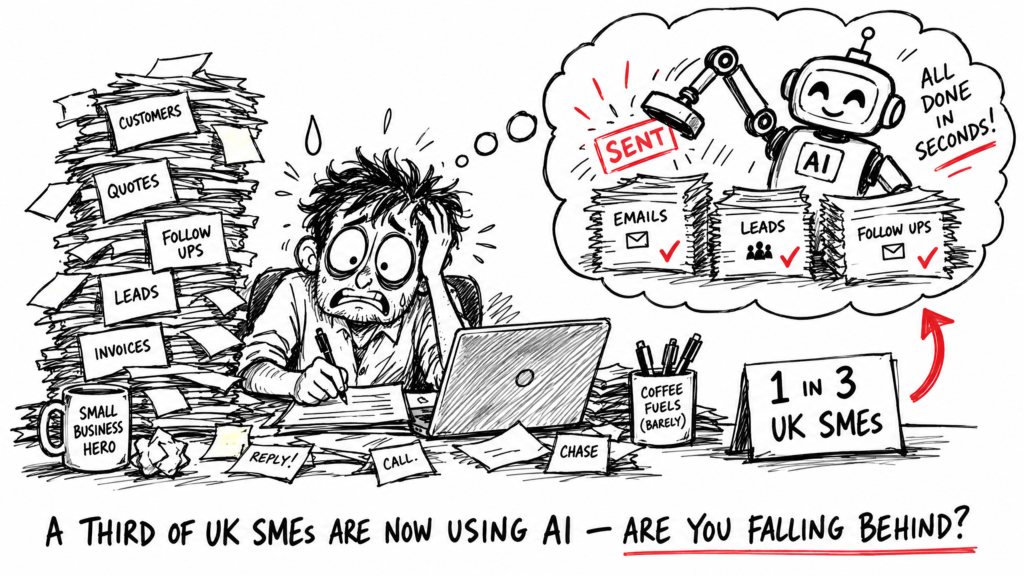
If it feels like every other business owner is suddenly talking about AI, that’s not just noise — the numbers have moved. Just over a third of UK small and medium-sized businesses were actively using AI in 2025, up from a quarter the year before. For a lot of business owners, the question isn’t “should I look into this” any more. It’s “what’s everyone else actually doing with it, and am I already behind.”
Key Takeaway: AI adoption among UK SMEs has grown from 23% in 2023 to over a third in 2025, and the businesses seeing real payback are focusing on a handful of specific, repetitive tasks — not trying to “do AI” everywhere at once.
In this article, you’ll learn:
- What’s driven the jump in AI adoption among UK small businesses
- The four areas where AI automation is actually delivering a return
- Why smaller businesses are still lagging behind larger ones
- What day-to-day AI use looks like for a small business, in practice
- A realistic way to start without a big, risky overhaul
1. What’s Actually Changed in 2026
AI adoption among UK businesses has moved fast. Roughly a quarter of all UK businesses were using some form of AI by late 2025, up from under 10% two years earlier. Among SMEs specifically, uptake has climbed from 23% in 2023, to 25% in 2024, to just over a third in 2025 — and 2026 is shaping up to be the year it stops being optional for businesses that want to stay competitive.
That doesn’t mean every business has rolled out some sweeping AI strategy. For most, it’s smaller and more practical than that: a tool that drafts a first reply to a customer enquiry, a system that flags which leads need following up today, a bot that answers the same internal question so staff don’t have to.
2. The Four Places AI Is Actually Paying Off
Industry data points to four specific areas where UK SMEs are seeing the clearest return on AI automation:
| Use case | What it does |
|---|---|
| Lead response automation | Replies to new enquiries within minutes instead of hours, so fewer leads go cold |
| Customer support triage | Sorts and routes incoming queries so the right person sees the right message first |
| Content drafting | Produces a first draft of routine writing — emails, posts, descriptions — for a human to check and send |
| Internal knowledge bots | Answers repeated internal questions (policies, pricing, processes) without pulling a person away from their work |
These four typically pay for themselves within 6–12 months, and businesses using them report saving somewhere between 20% and 50% of the time previously spent on that repetitive admin.
Pro Tip: Start with whichever of these four is costing you the most time right now, not whichever sounds the most impressive. A lead response tool that saves two hours a week is worth more to a small business than an ambitious project that never gets finished.
3. Why Adoption Still Lags for the Smallest Businesses
The growth is real, but it isn’t even. Large UK firms with 250+ staff reached 36% AI adoption in 2025. Micro-businesses — the one and two-person operations — sit at around 14%.
That gap comes down to two things: time and trust. A larger business can put someone in a room for a week to evaluate tools and build a rollout plan. A sole trader or small team doesn’t have that spare capacity, and a badly chosen tool that wastes a weekend is a real cost, not just an inconvenience. There’s also understandable caution about handing a customer-facing task — like replying to enquiries — over to something automated, without knowing exactly what it’ll say.
Both of those are solvable. The businesses making progress aren’t the ones with the most time — they’re the ones who picked one narrow, low-risk task to automate first, rather than trying to modernise everything at once.
4. What “Using AI” Actually Looks Like Day to Day
Away from the headline stats, most small businesses using AI aren’t running anything dramatic. A typical setup looks more like:
- A new enquiry lands, and an automated first reply goes out within minutes acknowledging it and asking the right qualifying questions
- A booking or quote request gets logged and assigned automatically, instead of sitting in an inbox until someone has time
- Routine questions — “what are your hours,” “do you cover this area” — get answered instantly, day or night, without tying up a person
- A first draft of a follow-up email or social post gets written automatically, ready for a quick check before it goes out
None of that replaces the judgement calls a business owner makes. It just clears the repetitive groundwork out of the way first.
5. How to Start Without Overhauling Everything
The businesses getting this right treat it as a series of small, contained changes rather than one big project:
- Pick one task that’s genuinely repetitive and currently eats real time — not a hypothetical future problem.
- Automate that one thing properly, with a human still able to check or override it.
- Measure what it actually saved — hours, missed leads, response time — before deciding what to automate next.
- Only then move on to the next task, using what you learned the first time.
This is a smaller, safer version of the same principle larger businesses use when they roll out change gradually rather than all at once. It also means if a tool genuinely doesn’t work for your business, you’ve lost a week, not three months.
Frequently Asked Questions
Is AI automation only worth it for bigger businesses?
No — the ROI data specifically points to small automations (lead response, support triage, drafting, internal Q&A) as the highest-payback areas, and those are just as relevant to a five-person business as a fifty-person one.
Will AI automation replace the way I talk to my customers?
Not if it’s set up properly. The most common approach is AI handling the first response or the routine questions, with a real person still making the actual decisions and handling anything that needs judgement.
How long does it take to see a return?
Industry data on the four highest-ROI use cases (lead response, support triage, content drafting, internal knowledge bots) shows payback typically within 6–12 months, often sooner for something as simple as automated lead replies.
What if I’ve never used any AI tools before?
Start with one task, not a full system. A single automation — like an instant reply to new enquiries — is a realistic first step and doesn’t require any technical background to use day to day.
Is this expensive to set up?
It depends entirely on the scope — a simple automation is a lot cheaper than a full system integration. The right approach is to scope the specific task you want automated and get a quote for that, rather than assuming it needs a big budget.
Conclusion
The shift isn’t that AI has suddenly become essential overnight — it’s that the businesses using it for genuinely repetitive tasks (chasing leads, answering the same questions, drafting routine replies) are quietly getting hours back every week, and that gap is only going to widen through 2026. You don’t need to overhaul how your business runs to start closing it. You need one well-chosen automation, set up properly.
If you’re not sure where to start, get in touch and we’ll look at where your business is losing the most time to repetitive tasks — then talk through what’s actually worth automating first. See more on AI Business Automation & Systems.
Related Articles
Written by MTU Projects.