
Business Systems
1 September 2026
What Is the ICM Framework? Getting Your Business AI-Ready
Introduction
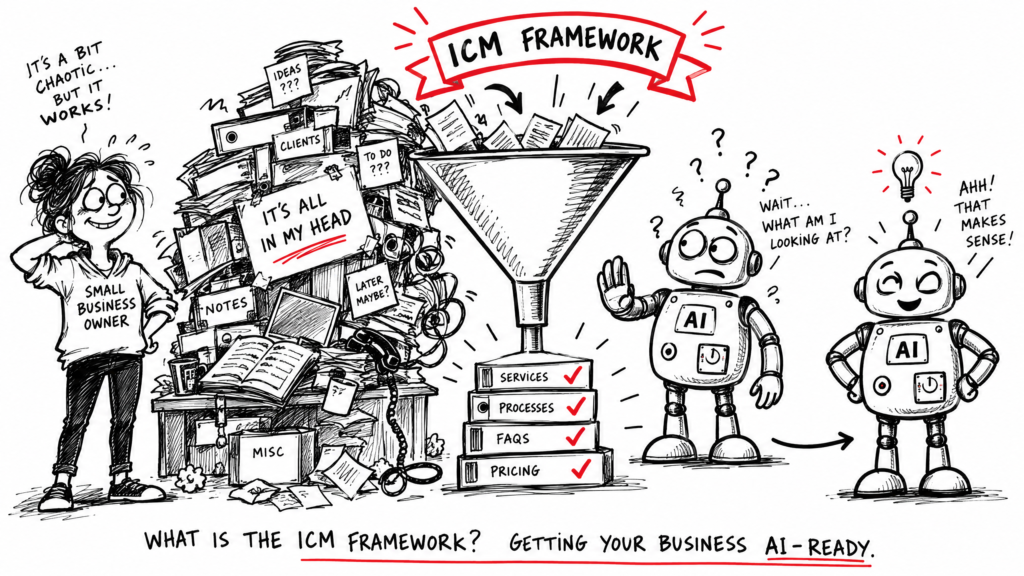
Most small businesses have their information scattered — pricing in one spreadsheet, processes remembered rather than written down, customer answers repeated from memory every time. That’s fine until you try to use AI tools properly, because AI is only as useful as the information you can actually hand it. The ICM Framework is how we fix that before any AI work starts.
Key Takeaway: AI tools can’t work with information that only exists in someone’s head — getting your business’s information organised properly is the actual prerequisite for AI paying off, not the AI tool itself.
In this article, you’ll learn:
- What “AI readiness” actually means in practice
- Why scattered information quietly costs more than it seems
- What the ICM Framework covers
- What a typical setup looks like
- How to tell if your business needs this yet
1. What “AI readiness” actually means in practice
AI readiness isn’t about buying a subscription to a chatbot tool. It means your business’s core information — services, pricing, processes, past decisions — exists somewhere consistent and structured enough that an AI tool (or a new employee) could actually use it.
A simple test
Could someone new to your business answer a routine customer question correctly using only what’s written down, without asking you directly? If not, that information exists only in your head — which means AI tools can’t use it either.
2. Why scattered information quietly costs more than it seems
Where it shows up
- Repeating the same explanation to different customers, worded slightly differently each time
- Pricing decisions made from memory, inconsistent between enquiries
- Processes that only work because one person remembers all the steps
Why this matters more once AI is involved
An AI tool given inconsistent or incomplete information will confidently produce inconsistent or incomplete answers — it doesn’t know what it doesn’t have, so the gaps in your organisation become gaps in whatever the AI produces.
3. What the ICM Framework covers
Core components
- Business and workflow discovery — understanding how the business actually runs today, not how it’s assumed to run
- An AI-ready folder structure for core business information
- Organising the operating information itself — services, pricing, policies, processes
- Documenting workflows and processes clearly enough for someone else to follow
- Prioritising which repeatable tasks, SOPs and prompts are worth building first
4. What a typical setup looks like
The general shape of the work
| Stage | What happens |
|---|---|
| Discovery | Understanding the business, its workflows and existing information |
| Structure | Building the folder structure and organising core information into it |
| Documentation | Writing up workflows and processes clearly |
| Handover | Agreeing the setup for your ongoing AI-assisted working environment |
Exactly what’s included is agreed and stated in the proposal for each business — the folders, workflows, documents and setup items vary depending on what the business already has and what it’s missing.
5. How to tell if your business needs this yet
Signs it’s worth doing
- You’ve tried using an AI tool and the results were generic or wrong, because it had nothing specific to work from
- Key processes only work because one person remembers all the steps
- You’re planning to use AI more but don’t know where to start with what to give it
Pro Tip: Start with the single process you explain most often to customers or staff — writing that one down properly is a small, concrete first step before organising everything else.
Frequently Asked Questions
Do I need existing AI tools in place before this is worth doing?
No — in fact it’s usually more useful done first, so whatever AI tools you adopt later have something proper to work from.
How long does a typical setup take?
It depends on how much is already organised and how much needs to be built from scratch — scoped individually per business.
Is this just tidying up my Google Drive?
It overlaps with that, but goes further — documenting workflows and processes properly, not just filing existing documents into folders.What happens to the information once it’s organised?
It’s yours — the point is a structure and set of documents your business can keep using and adding to, not something dependent on staying with any particular tool.
How much does this cost?
Scoped individually based on exactly which folders, workflows and documentation are included — stated plainly in the proposal before any work starts.
Conclusion
AI tools are only as useful as the information you give them. The ICM Framework is how we get a business’s information, workflows and processes organised properly first — the actual prerequisite for AI work paying off, rather than the AI tool itself.
See our Business Information Organisation & AI Readiness service for more detail, or get in touch to talk through where your business currently stands.
Related Articles
- AI Business Automation & Systems — the automation work this framework sets you up for
- What Is an AI Visibility Audit? — a related but distinct piece of AI readiness
Written by MTU Projects.