
SEO
3 October 2026
Why Does My Competitor Show Up on Google Maps and I Don’t? The Honest Answer
Introduction
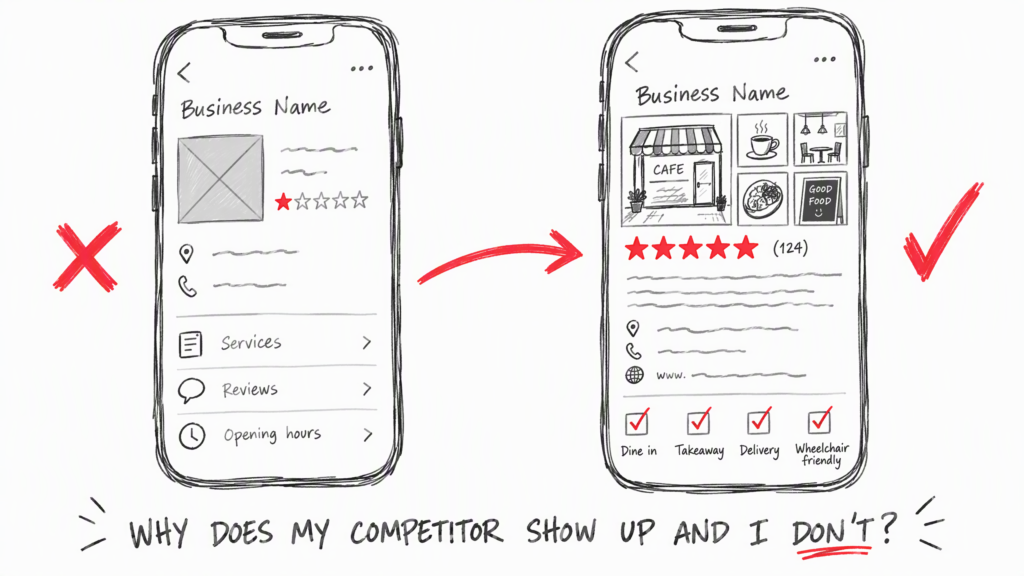
You search for your own trade in Leeds and there’s your competitor, right on the map. You’ve been doing the job for years. Your work is as good as theirs, probably better. So why them and not you? The honest answer is rarely “they’re better at the job”. It’s usually that their profile tells Google more, and tells it more convincingly.
Key Takeaway: Google decides who shows on the map using three things: relevance, distance and prominence. You can’t change distance, but a competitor who beats you is usually winning on the other two, and you can catch up on both.
In this article, you’ll learn:
- The three things Google uses to rank local businesses
- Why distance isn’t the end of the story
- How relevance and prominence decide close contests
- How to compare your profile against a competitor properly
- What the gap usually turns out to be
1. Google Ranks Local Businesses on Three Things
Google has published how local results are ranked. In plain English:
| Factor | What Google means | Can you change it? |
|---|---|---|
| Relevance | How well your profile matches what the person searched for | Yes |
| Distance | How far you are from the person searching | No |
| Prominence | How well-known your business is | Yes, over time |
There’s no secret fourth factor. Google also says you can’t request or pay for a better local ranking. Adverts marked as sponsored are a separate thing, and the map listings underneath them aren’t bought.
2. Distance: The One You Can’t Change
If your competitor’s premises are closer to the person searching, that gives them an edge, and you can’t move your shop to fix it. Google uses the searcher’s location, or a known location if they haven’t shared one.
Two things to take from that. First, it explains why a competitor can appear above you from one street and below you from another. It isn’t random. Second, distance only decides things when everything else is level. A closer business with a thin, neglected profile can still lose to a slightly further one with a complete, active profile. That’s the part you can work on.
3. Relevance: Does Google Know What You Do?
Relevance is about matching the search. If someone searches “emergency electrician” and your profile never says you do emergency callouts, you’re asking Google to guess.
What to check on your profile:
- Main category: it should say exactly what you do. A near-miss category costs you searches.
- Other categories and services: list everything you genuinely offer, not just the first thing you set up.
- Description: plain and factual. What you do, who for and where. No sales slogans.
- Service area: the places you actually cover, set correctly.
- Business information: complete and current. Google’s own advice is to keep it that way.
A competitor with a full profile gives Google more to match against more searches. That’s often the whole story.
4. Prominence: How Well-Known You Look
Prominence is Google’s measure of how well-known a business is. Google says more reviews and positive ratings help, and it also looks at how many other websites link to your business.
In practice, that means:
- Reviews: how many, how good and how recent. Replying to them shows you’re active, and Google says positive reviews and helpful replies help you stand out.
- Photos and videos: real ones, added regularly.
- Links and mentions: other websites referring to you, such as local directories, suppliers or press.
- A website that backs the profile up: the same business details, clear about what you do.
This is the one that takes time. A competitor who has been asking happy customers for reviews for three years has a head start, but a head start can be closed.
5. How to Compare Yourself Fairly
Open your profile and your competitor’s side by side on your phone and go through this list:
- Main category: the same as yours, or more specific?
- Number of reviews and average rating: the gap, in plain numbers.
- Most recent review: this week, or six months ago?
- Do they reply to reviews? And do you?
- Photos: how many, and how recent?
- Services and description: how much have they filled in compared with you?
- Website: does the profile link to a proper site that matches?
Write the answers down. Usually two or three of those stand out. That’s your list, and it’s a better use of an evening than guessing.
Sometimes the honest answer is that they’re simply closer, or have been established longer, and you won’t catch them on every search. Even then you can win the searches around the edges: other parts of Leeds, specific services, and “near me” searches from where you are strongest.
Frequently Asked Questions
Is my competitor paying Google to rank above me?
Not for the map listings. Google says you can’t pay for a better local ranking. If you see a result labelled as sponsored, that’s an advert.
Does having more reviews guarantee a higher ranking?
No. Reviews are one part of prominence, and Google weighs relevance and distance as well. But a profile with very few reviews is at a disadvantage against one with plenty of recent ones.
Can I do anything about distance?
Not about where you are. You can make sure your service area is set correctly, so you appear for the places you actually cover.
How long does it take to catch up?
It depends on the gap and how competitive your trade is in Leeds. Profile fixes can show up quickly. Building reviews and reputation takes longer, and nobody can honestly promise a date.
Should I just copy what my competitor has done?
Use them as a checklist, not a template. Match anything they do well, then add what makes you different: your services, your area, your real photos and your own customers’ reviews.
Conclusion
When a competitor shows up on the map and you don’t, it comes down to relevance, distance and prominence. You can’t change the distance, but you can make your profile clearer about what you do and build up a reputation that backs it up. Compare your profile against theirs, find the two or three biggest gaps, and fix those first.
Want to know where you actually stand? Book a free Local Visibility Check: a 20-minute call and a one-page list of the most obvious problems holding your profile back.
Related Articles
- The Five Things Killing Your Local Search Ranking
- How to Rank in Leeds’ Local Pack: A Local SEO Checklist
Written by MTU Projects.