
Strategy
12 October 2026
Where Do Your Enquiries Actually Come From? How to Track Leads Without a Dashboard
Introduction
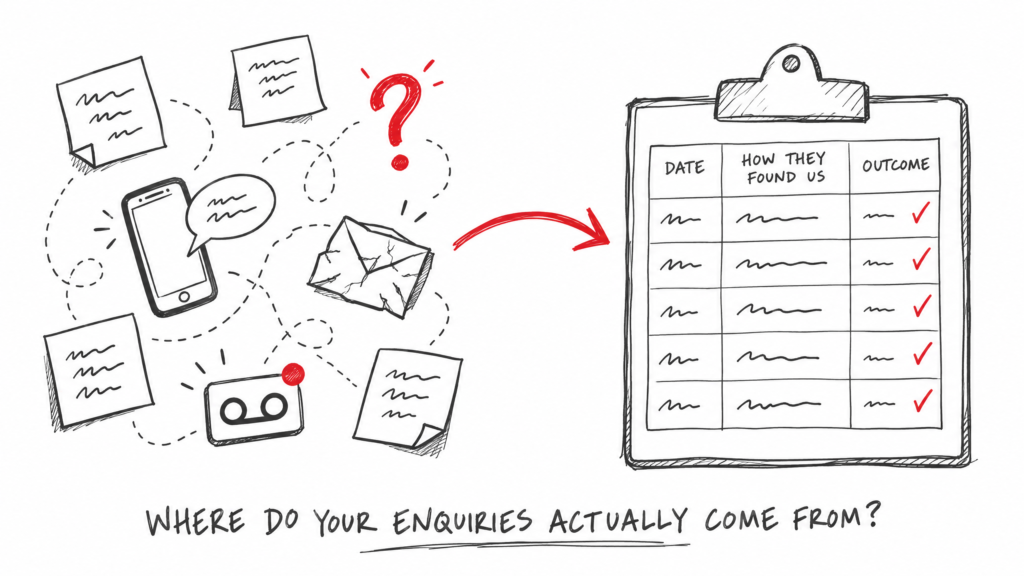
Ask most small business owners where their work comes from and you’ll hear “mostly word of mouth”. It might be true. But a lot of the time nobody has checked, and the business is spending time and money on the strength of a feeling. You don’t need analytics software to find out. You need one question and one list.
Key Takeaway: Ask every new enquiry how they heard about you, and write the answer in the same place every time. After a month you’ll have real evidence about what’s working, and it costs nothing.
In this article, you’ll learn:
- Why “word of mouth” is often a guess
- The one question that gives you the answer
- A simple enquiry log you can start today
- How to ask the question on the phone, in messages and on your website
- What to look at after a month and what to do with it
1. Why “Word of Mouth” Is Usually a Guess
Word of mouth is a catch-all. A customer who says “my neighbour recommended you” may also have looked you up on Google before ringing. Someone who “saw your van” may have found your website afterwards and used the contact form. Without a record, every enquiry gets filed under whichever route you remember first.
The cost shows up when you decide where to put your effort. If you assume it’s all recommendations, you might neglect your Google Business Profile. If you assume Google sends everything, you might skip the follow-up that keeps past customers recommending you. You can’t tell which is true from memory.
2. The One Question to Ask Every New Enquiry
“How did you hear about us?”
That’s it. Ask it early, in a friendly, curious tone, not as part of a form-filling routine. Something like:
“Just so I know where to put my effort, how did you find us?”
Then listen for the real answer. A few things help:
- Offer a short list if they’re stuck. Google search, Google Maps, a recommendation, Facebook, the van or signage, a returning customer, or something else.
- Follow up on “a recommendation”. Ask who recommended you. It helps you thank them, and it tells you which past customers are sending you work.
- Note “Google” properly. Was it a search, or the map? They’re different routes with different fixes.
- Accept “I can’t remember”. Write that down too. If a lot of people say it, that’s a clue as well.
3. Where to Write the Answer Down
The best place is the one you’ll actually use. A notebook in the van works. So does a spreadsheet, or a note on your phone. What matters is that it’s always in the same place and always the same columns.
| Date | Name | How they found us | What they wanted | Replied? | Outcome |
|---|---|---|---|---|---|
| 6 Oct | Customer A | Google Maps | Boiler service | Same day | Booked |
| 7 Oct | Customer B | Recommendation (Customer C) | Bathroom quote | Next day | Quote sent |
| 9 Oct | Customer D | Van | Radiator repair | Same day | Lost |
The names and jobs above are made up, to show the shape of the list.
Add the outcome column even if it feels like extra work. “How they found us” tells you where enquiries come from. “Outcome” tells you which routes bring jobs worth having.
4. Ask It Wherever Enquiries Arrive
Enquiries don’t all arrive in the same way, so the question needs to travel with them.
- On the phone: put it near the start of the call. A sticky note by the phone is enough as a reminder.
- WhatsApp, Facebook and email: add it to your first reply. “Thanks for getting in touch. How did you hear about us?”
- On your website: add a “How did you hear about us?” box to the contact form, ideally a short dropdown with the same options as your list. It’s quick to answer and quick to count. If your website is out of date, a website that’s built to bring in enquiries is a better place to ask than a form nobody fills in.
- After the event: if you forgot at the time, ask when you send the quote or the invoice.
One note on Google’s own numbers: your Google Business Profile may show how many people tapped the call or website buttons, where that report is available to you. Taps are a useful clue, but a tap isn’t an enquiry, and it can’t tell you who became a customer or why they chose you. Your own list can.
5. What to Look At After a Month
After four weeks, count how many enquiries came from each route and how many turned into jobs. You’re looking for three things:
- Which route brings the most enquiries. That’s where you’re already visible.
- Which route brings jobs, not just enquiries. Ten enquiries that never book are worth less than three that do.
- Which route is missing. If nobody ever says Google, your profile may need attention.
Here is an example, with made-up figures, of what a small month might show:
| Route | Enquiries | Jobs booked |
|---|---|---|
| Recommendation | 6 | 5 |
| Google Maps | 4 | 2 |
| 3 | 0 | |
| Van | 1 | 1 |
In that example, the recommendations are doing the heavy lifting, Google Maps is bringing enquiries that need better handling, and Facebook is bringing attention but no work. Those are three different jobs, and you’d never have seen them without the list.
Then decide one thing to do. Not five. If Google Maps brings enquiries but few jobs, check how fast you reply. If recommendations are strong, thank the people sending them. If a route never brings work, stop putting time into it.
Frequently Asked Questions
Do I need software to track where enquiries come from?
No. A notebook or spreadsheet is enough to start. Software becomes worth it when you have more enquiries than you can keep track of by hand.
What if customers don’t remember how they found me?
Write “can’t remember” and move on. If it’s most of your customers, ask earlier in the conversation, or offer a short list of options so they only have to pick one.
Should I track phone calls separately?
Only if you need to. Start by asking everyone, on every channel, and recording the answer in one list. That already covers calls.
Is it a problem to keep a list of enquirers’ names and numbers?
You’re probably already holding that information in your phone and inbox. Keep the list somewhere private, record only what you need, and check the Information Commissioner’s Office guidance if you’re unsure how it applies to your business.
How long before the numbers mean anything?
A month gives you a first impression. Three months is better, because one odd week won’t skew it.
Conclusion
“Most of our work comes from word of mouth” might be true, and it’s worth knowing for sure. Ask every enquiry how they found you, keep the answers in one list, and look at it after a month. It’s the cheapest marketing research you’ll ever do, and it tells you where to put your time and money next.
If you’d like help working out what your results mean, book a free Local Visibility Check: a 20-minute call and a one-page list of the most obvious problems holding your enquiries back.
Related Articles
- Is Your Business Invisible on Google Maps? The 60-Second Test for Leeds Businesses
- The Five Things Killing Your Local Search Ranking
Written by MTU Projects.